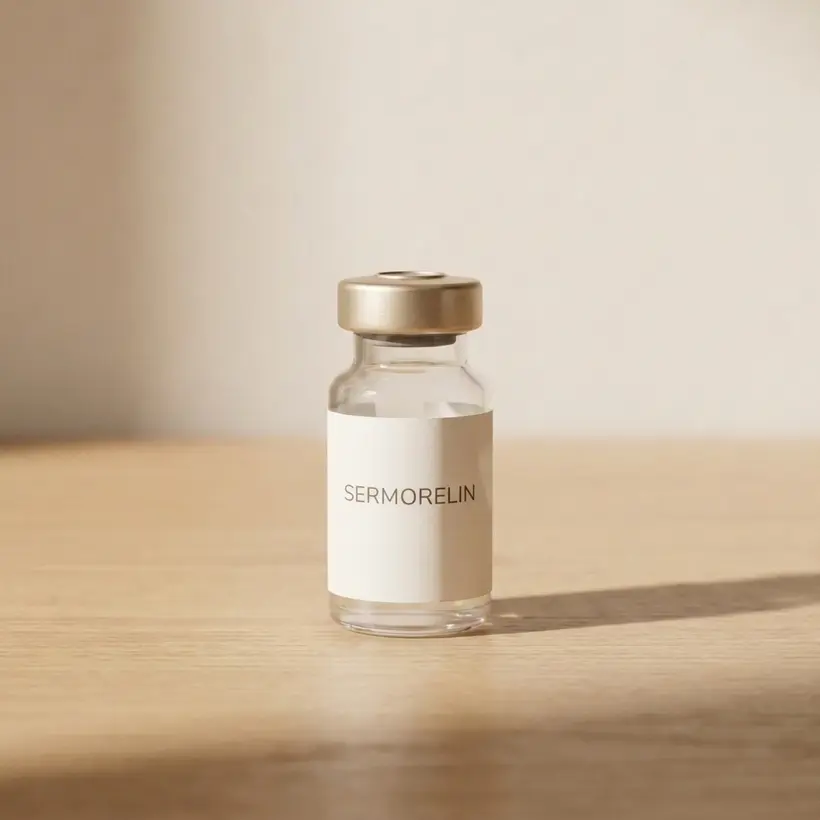
Sermorelin
Top SellerInjectable

Growth & Performance

A GHRH analog studied for natural growth hormone pulsatility

01

Studied in research for stimulating pulsatile GH release from pituitary somatotrophs

02

Physiological negative feedback via somatostatin and IGF-1 remains intact

03

A controlled trial in 118 GH-deficient adults reported 30-40% IGF-1 increases over 6 months

Growth & Performance

Sermorelin

Sermorelin is a 29-amino-acid analog of growth hormone-releasing hormone (GHRH) studied in research for stimulating the pituitary to release growth hormone in its natural pulsatile pattern.

15mg vial · 3mg/mL · 5mL99.3% purity

Choose your plan

Peptide checkout

1. Purchase type

2. Choose billing term

How this plan works

Pay

$429.30 today

Renews every 3 months

Ship

Every 3 months

After provider approval

Refills

Paid quarterly

Continues until canceled

Continue with 3-month plan → $429.30
Peptide checkout
Provider review
Ships after approval

A U.S.-licensed provider reviews your request before it ships. If you are not approved, you are refunded in full.

Quick answer

Sermorelin is a 29-amino-acid analog of growth hormone-releasing hormone (GHRH) studied in research for stimulating the pituitary to release growth hormone in its natural pulsatile pattern.

Format

Injectable

Best use

Growth & Performance

Evidence

Research-framed

503A Pharmacy
USP <797> Sterile
Provider-Reviewed
Lab-Tested
Cold-Chain
HIPAA

Deep research

About Sermorelin

Sermorelin, formally designated GRF(1-29)NH2, is a synthetic 29-amino-acid peptide corresponding to the first 29 residues of the 44-amino-acid human growth hormone-releasing hormone (GHRH), with a molecular weight of approximately 3,358 Da. The C-terminal amidation is critical for full biological activity, as the free-acid form shows significantly reduced receptor binding.

Lyophilized sermorelin is reconstituted with bacteriostatic water (0.9% benzyl alcohol), stored refrigerated at 2-8C, and used within 30 days. Lyophilized powder is kept at -20C for long-term storage, and repeated freeze-thaw cycles are avoided since they can degrade the peptide.
Key benefits

What researchers have looked at

1

Studied in research for stimulating pulsatile GH release from pituitary somatotrophs

2

Physiological negative feedback via somatostatin and IGF-1 remains intact

3

A controlled trial in 118 GH-deficient adults reported 30-40% IGF-1 increases over 6 months

4

Body-composition changes reported in that trial: +3.2 kg lean mass, -2.8 kg fat mass

5

Polysomnographic research reported about 25% more slow-wave sleep in subjects over 50

6

Previously FDA-approved as Geref; discontinued in 2008 for commercial, not safety, reasons

7

Exercise-capacity improvements of 8-10% VO2 max reported in clinical research

8

Short plasma half-life (10-20 minutes) with a downstream GH pulse lasting 2-3 hours

Mechanism

How Sermorelin is positioned in research

Sermorelin acts as a selective agonist at the GHRH receptor (GHRHR), a class B G-protein-coupled receptor on anterior pituitary somatotrophs. Binding activates adenylyl cyclase via Gs-alpha, raising cAMP and triggering PKA-mediated phosphorylation of CREB and Pit-1, which drives growth hormone gene expression and vesicular release. Because it works upstream of GH itself, the native negative feedback via somatostatin and IGF-1 remains intact. Pharmacokinetics: peak plasma concentration within 5-20 minutes, elimination half-life about 10-20 minutes, with the downstream GH pulse lasting 2-3 hours and IGF-1 elevation persisting 12-18 hours, which is why bedtime dosing is described in the literature.

Published research

What the research has explored

A controlled trial published in the Journal of Clinical Endocrinology and Metabolism enrolled 118 GH-deficient adults and reported a 30-40% increase in serum IGF-1 over 6 months of nightly subcutaneous dosing, with +3.2 kg lean mass and -2.8 kg fat mass (p < 0.01 for both). Polysomnographic studies reported approximately 25% more slow-wave sleep in subjects over 50 (Sleep Medicine Reviews). Sermorelin was FDA-approved as Geref (diagnostic 1997, therapeutic for pediatric GH deficiency) and discontinued in 2008 by EMD Serono for commercial reasons. A 2002 review in Growth Hormone and IGF Research covering over 1,000 treated patients found no evidence of increased cancer risk, glucose intolerance, or antibody-mediated resistance with long-term use.

For research and educational purposes only. References to studies describe published literature and do not constitute medical claims, efficacy guarantees, or treatment recommendations.

Questions people ask

Frequently asked questions

What is Sermorelin?+

Sermorelin (GRF(1-29)NH2, MW ~3,358 Da) is a synthetic analog of the first 29 amino acids of human growth hormone-releasing hormone, studied in research for stimulating natural pulsatile GH release. It was previously FDA-approved as Geref.

How is it different from taking growth hormone?+

Sermorelin works upstream at the pituitary, so somatostatin and IGF-1 negative feedback stays intact. The literature associates this with avoiding the supraphysiological GH levels of exogenous GH injection.

How is Sermorelin stored?+

Lyophilized powder is stored at -20C, reconstituted with bacteriostatic water, refrigerated at 2-8C, and used within 30 days, avoiding repeated freeze-thaw cycles.

Concentration

3mg/mL · 5mL

Purity

99.3%

Format

Injectable

Vial

15mg vial

Compare next

Related peptides