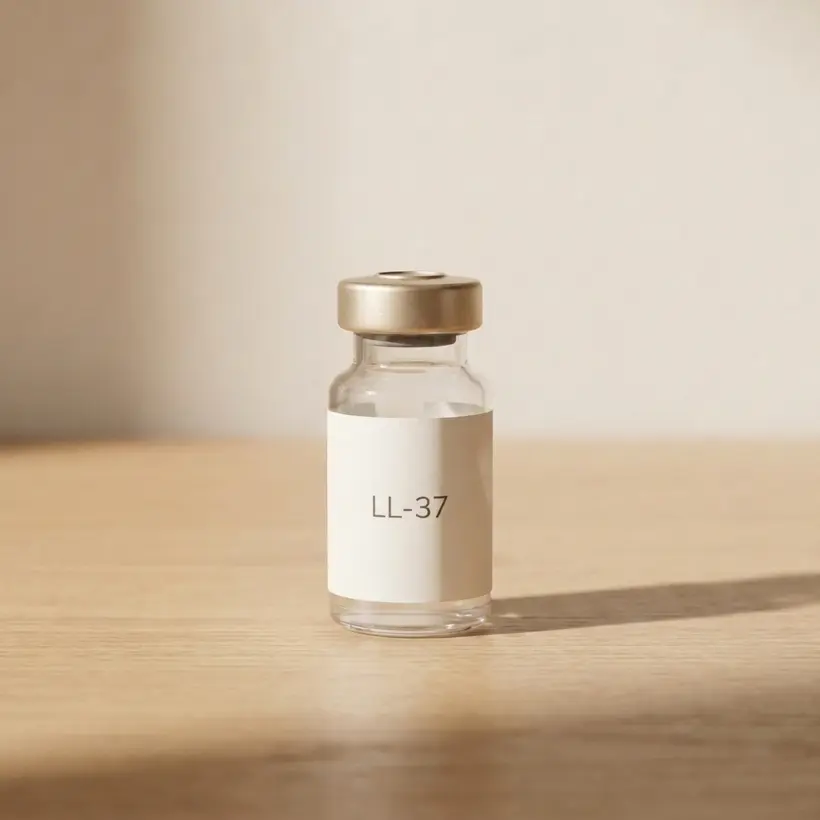
LL-37
Injectable

Immune & Wellness

A human cathelicidin peptide studied in antimicrobial and immune research

01

The only human cathelicidin, studied in innate-immunity research

02

Research describes broad-spectrum antimicrobial activity in vitro

03

Investigated for its binding of bacterial endotoxin (LPS) via the lipid A moiety

Immune & Wellness

LL-37

LL-37 is the only human cathelicidin antimicrobial peptide, studied in research for its broad antimicrobial activity and its role in immune signaling.

10mg vial · 2mg/mL · 5mL98.8% purity

Choose your plan

Peptide checkout

1. Purchase type

2. Choose billing term

How this plan works

Pay

$483.30 today

Renews every 3 months

Ship

Every 3 months

After provider approval

Refills

Paid quarterly

Continues until canceled

Continue with 3-month plan → $483.30
Peptide checkout
Provider review
Ships after approval

A U.S.-licensed provider reviews your request before it ships. If you are not approved, you are refunded in full.

Quick answer

LL-37 is the only human cathelicidin antimicrobial peptide, studied in research for its broad antimicrobial activity and its role in immune signaling.

Format

Injectable

Best use

Immune & Wellness

Evidence

Research-framed

503A Pharmacy
USP <797> Sterile
Provider-Reviewed
Lab-Tested
Cold-Chain
HIPAA

Deep research

About LL-37

LL-37 is the only member of the cathelicidin antimicrobial peptide family found in humans. It is a 37-amino-acid peptide (MW ~4,493 Da) beginning with two leucine residues (hence LL-37). It is cleaved from its precursor protein hCAP18 by proteinase 3 in neutrophils and by kallikreins in keratinocytes. The gene encoding hCAP18/LL-37 is CAMP, located on chromosome 3, and its transcription is regulated by vitamin D.

Lyophilized LL-37 is stored at -20C and reconstituted solutions are refrigerated at 2-8C. The peptide can adsorb to glass and plastic at low concentrations, so low-binding polypropylene tubes are recommended. Solutions should be clear; turbidity indicates aggregation and loss of activity.
Key benefits

What researchers have looked at

1

The only human cathelicidin, studied in innate-immunity research

2

Research describes broad-spectrum antimicrobial activity in vitro

3

Investigated for its binding of bacterial endotoxin (LPS) via the lipid A moiety

4

Studied in research on bacterial biofilms

5

Examined as a chemoattractant for neutrophils, monocytes, and T-cells via FPRL1

6

Studied for its role in keratinocyte migration and VEGF-related angiogenesis

7

Research links its expression to vitamin D signaling (CAMP gene)

8

Examined for antiviral activity against enveloped viruses in laboratory studies

Mechanism

How LL-37 is positioned in research

Research describes LL-37 adopting an amphipathic alpha-helical structure on contact with bacterial membranes, where it is associated with membrane disruption. Beyond direct antimicrobial activity, the literature describes immunomodulatory signaling: it acts as a chemoattractant via FPRL1, is associated with keratinocyte migration and VEGF-related angiogenesis, and binds the lipid A moiety of lipopolysaccharide (LPS). Plasma half-life is approximately 30-60 minutes.

Published research

What the research has explored

LL-37 has been studied in laboratory and preclinical research across antimicrobial, anti-biofilm, and wound-healing models, with reported work published in PLoS ONE and Antimicrobial Agents and Chemotherapy. Research has also examined the vitamin D-LL-37 axis (vitamin D regulates CAMP gene transcription). At physiological concentrations LL-37 is described as well tolerated; at high concentrations it can show cytotoxicity to mammalian cells, underscoring the importance of appropriate dosing in research.

For research and educational purposes only. References to studies describe published literature and do not constitute medical claims, efficacy guarantees, or treatment recommendations.

Questions people ask

Frequently asked questions

What is LL-37?+

LL-37 is the only human cathelicidin antimicrobial peptide, a 37-amino-acid amphipathic peptide (MW ~4,493 Da) cleaved from the hCAP18 precursor. It is studied in antimicrobial and immune research.

What is the vitamin D connection?+

Vitamin D regulates transcription of the CAMP gene that encodes LL-37, a relationship studied in research on immune defense.

How is LL-37 stored?+

It is stored lyophilized at -20C and refrigerated at 2-8C after reconstitution, ideally in low-binding polypropylene tubes since it can adsorb to surfaces.

Concentration

2mg/mL · 5mL

Purity

98.8%

Format

Injectable

Vial

10mg vial

Compare next

Related peptides