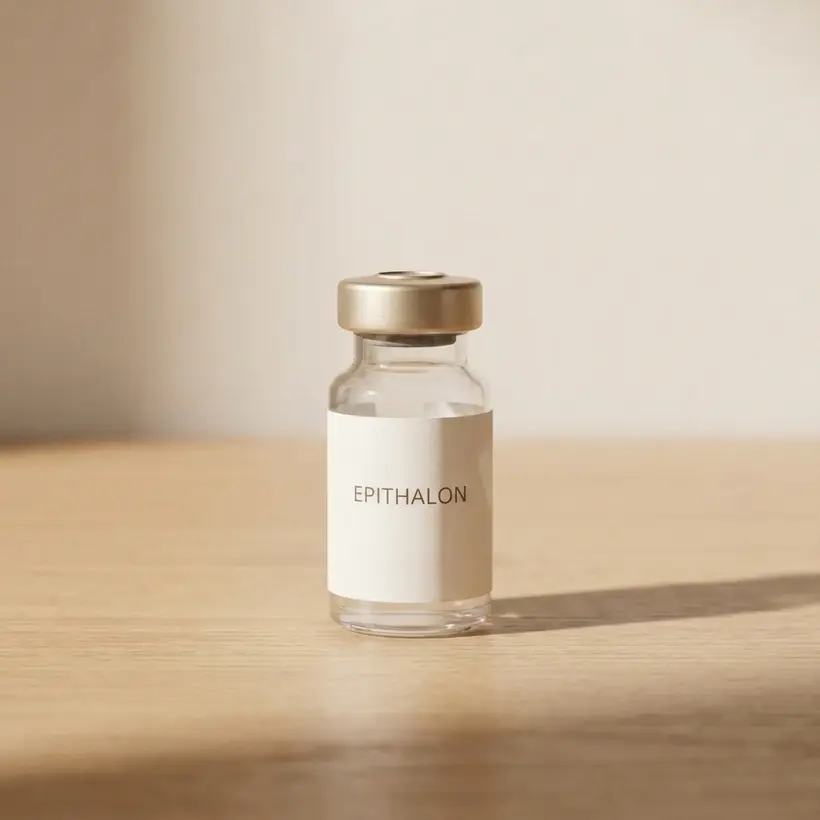
Epithalon (Epitalon)
Most PopularInjectable

Anti-Aging & Longevity

A tetrapeptide studied in telomere and longevity research

01

Studied in research for its role in telomerase (hTERT) activity

02

Research has explored its effect on melatonin secretion and circadian rhythm

03

Investigated in longevity and aging models

Anti-Aging & Longevity

Epithalon (Epitalon)

Epithalon is a synthetic tetrapeptide that activates telomerase, the enzyme responsible for maintaining telomere length.

10mg vial · 2mg/mL · 5mL99.3% purity

Choose your plan

Peptide checkout

1. Purchase type

2. Choose billing term

How this plan works

Pay

$483.30 today

Renews every 3 months

Ship

Every 3 months

After provider approval

Refills

Paid quarterly

Continues until canceled

Continue with 3-month plan → $483.30
Peptide checkout
Provider review
Ships after approval

A U.S.-licensed provider reviews your request before it ships. If you are not approved, you are refunded in full.

Quick answer

Epithalon is a synthetic tetrapeptide that activates telomerase, the enzyme responsible for maintaining telomere length.

Format

Injectable

Best use

Anti-Aging & Longevity

Evidence

Research-framed

503A Pharmacy
USP <797> Sterile
Provider-Reviewed
Lab-Tested
Cold-Chain
HIPAA

Deep research

About Epithalon (Epitalon)

Epithalon (also written Epitalon) is a synthetic tetrapeptide with the sequence Ala-Glu-Asp-Gly and a molecular weight of approximately 390.35 Da. It was designed to replicate the biological activity of Epithalamin, a polypeptide extract isolated from the bovine pineal gland by Professor Vladimir Khavinson at the Saint Petersburg Institute of Bioregulation and Gerontology. Its four-residue structure makes it one of the smallest bioactive peptides studied in longevity research.

Lyophilized Epithalon is stored at -20C and is stable for extended periods. Once reconstituted with bacteriostatic water, the solution is refrigerated at 2-8C. The peptide is stable in solution at physiological pH (7.2-7.6) but degrades in strongly acidic conditions, and reconstitution is straightforward given its high aqueous solubility.
Key benefits

What researchers have looked at

1

Studied in research for its role in telomerase (hTERT) activity

2

Research has explored its effect on melatonin secretion and circadian rhythm

3

Investigated in longevity and aging models

4

Examined for its influence on antioxidant enzyme expression (SOD, glutathione peroxidase)

5

Studied for measures of T-cell immunity (CD3+, CD4+, CD4/CD8 ratio)

6

Among the smallest bioactive peptides studied in longevity research (4 residues)

7

Modeled on Epithalamin, a pineal gland extract studied by Khavinson

8

Over 35 years and 15+ clinical trials of published research

Mechanism

How Epithalon (Epitalon) is positioned in research

Research on Epithalon centers on telomerase, the enzyme that adds TTAGGG repeats to chromosome ends. Studies describe upregulation of the catalytic subunit hTERT and have measured changes in telomerase activity in human pulmonary fibroblasts. Its plasma half-life is estimated in minutes, but effects on gene expression are reported to persist longer, consistent with a hit-and-run signaling pattern. Research protocols commonly use subcutaneous injection in 10-20 day cycles.

Published research

What the research has explored

Published research on Epithalon and Epithalamin spans over 15 trials. Reported work includes telomerase activity studies in human fibroblasts (Khavinson et al., Bull Exp Biol Med, 2003), longevity studies in CBA mice (Anisimov et al., Biogerontology, 2003), and a 6-year clinical follow-up in elderly patients (N=266) examining melatonin and immune markers. Published safety data report no significant adverse effects across studied doses, with minimal injection site reactions.

For research and educational purposes only. References to studies describe published literature and do not constitute medical claims, efficacy guarantees, or treatment recommendations.

Questions people ask

Frequently asked questions

What is Epithalon?+

Epithalon (Epitalon) is a synthetic tetrapeptide (Ala-Glu-Asp-Gly, MW ~390.35 Da) modeled on the pineal extract Epithalamin. It is studied in telomere and longevity research.

What has Epithalon been studied for?+

Published research has explored its role in telomerase (hTERT) activity, melatonin and circadian rhythm, antioxidant enzyme expression, and immune markers. Much of this evidence comes from cell-culture and animal models.

How is Epithalon stored?+

It is stored lyophilized at -20C and, once reconstituted with bacteriostatic water, refrigerated at 2-8C. It is stable at physiological pH.

Concentration

2mg/mL · 5mL

Purity

99.3%

Format

Injectable

Vial

10mg vial

Compare next

Related peptides