GHK-Cu (Copper Peptide)
Injectable

Anti-Aging & Longevity

A copper peptide studied for skin and tissue support

01

Copper-binding tripeptide studied in research for skin and tissue support

02

Research has explored its broad influence on gene expression

03

Studied for its role in fibroblast collagen and glycosaminoglycan synthesis

Anti-Aging & Longevity

GHK-Cu (Copper Peptide)

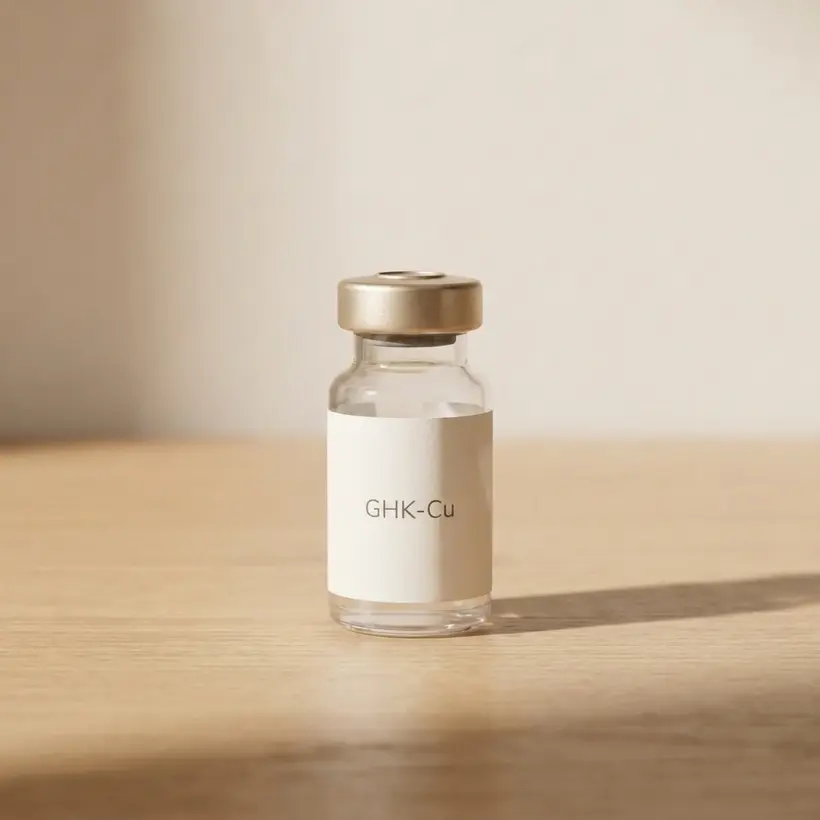
GHK-Cu is a naturally occurring copper-binding tripeptide that declines with age. It has been studied in laboratory research for its role in skin, tissue, and cellular support.

50mg vial · 10mg/mL · 5mL99.0% purity

Choose your plan

Peptide checkout

1. Purchase type

2. Choose billing term

How this plan works

Pay

$429.30 today

Renews every 3 months

Ship

Every 3 months

After provider approval

Refills

Paid quarterly

Continues until canceled

Continue with 3-month plan → $429.30
Peptide checkout
Provider review
Ships after approval

A U.S.-licensed provider reviews your request before it ships. If you are not approved, you are refunded in full.

Quick answer

GHK-Cu is a naturally occurring copper-binding tripeptide that declines with age. It has been studied in laboratory research for its role in skin, tissue, and cellular support.

Format

Injectable

Best use

Anti-Aging & Longevity

Evidence

Research-framed

503A Pharmacy
USP <797> Sterile
Provider-Reviewed
Lab-Tested
Cold-Chain
HIPAA

Deep research

About GHK-Cu (Copper Peptide)

GHK-Cu (glycyl-L-histidyl-L-lysine:copper(II)) is a naturally occurring tripeptide-copper complex with a molecular weight of approximately 403.93 Da including the copper ion. The peptide sequence Gly-His-Lys chelates a single Cu(II) ion through the histidine imidazole nitrogen and the deprotonated amide nitrogens of the backbone. GHK-Cu was first isolated from human plasma by Loren Pickart in 1973. Plasma levels of GHK-Cu decline with age, a change that has been studied in relation to regenerative capacity.

Lyophilized GHK-Cu is stored at -20C and protected from light, as the copper complex can undergo photodegradation. Reconstituted solutions are refrigerated at 2-8C. The compound is stable at pH 5.5-7.0 and is not mixed with chelating agents such as EDTA that would strip the copper ion. The blue-green color of the solution is normal and indicates intact copper coordination.
Key benefits

What researchers have looked at

1

Copper-binding tripeptide studied in research for skin and tissue support

2

Research has explored its broad influence on gene expression

3

Studied for its role in fibroblast collagen and glycosaminoglycan synthesis

4

Investigated in models of dermal thickness and skin appearance

5

Examined in bone and osteoblast research

6

Studied for neuroprotective signaling in cell-culture ischemia models

7

An endogenous compound first isolated from human plasma in 1973

8

Reported favorable tolerability in topical clinical research

Mechanism

How GHK-Cu (Copper Peptide) is positioned in research

Research using Connectivity Map (CMap) analysis (Iorio et al.) and work by Pickart and Campbell (2012) describes GHK-Cu modulating the expression of a large number of human genes, both up- and down-regulating sets associated with tissue repair, antioxidant defense, and inflammation. In dermatology research it is described as stimulating fibroblasts to produce collagen I, collagen III, decorin, and glycosaminoglycans. Its plasma half-life is estimated at 30-60 minutes, with gene-expression effects reported to persist longer.

Published research

What the research has explored

GHK-Cu has been studied in double-blind dermatology trials (e.g., Finkley et al., 2005) examining skin appearance and procollagen, in bone-regeneration models published in the Journal of Orthopaedic Research, and in neuronal cell-culture models of ischemia. Topical applications in clinical trials reported no irritation or sensitization. Given its endogenous origin, its tolerability profile is well documented in the literature.

For research and educational purposes only. References to studies describe published literature and do not constitute medical claims, efficacy guarantees, or treatment recommendations.

Questions people ask

Frequently asked questions

What is GHK-Cu?+

GHK-Cu is a naturally occurring copper-binding tripeptide (Gly-His-Lys complexed with Cu(II), MW ~403.93 Da) first isolated from human plasma in 1973. It is studied in research for skin and tissue support.

Why is the solution blue-green?+

The blue-green color reflects intact copper coordination in the complex and is normal. The peptide is protected from light and not mixed with chelators like EDTA that would strip the copper ion.

What has GHK-Cu been studied for?+

Published research has explored its influence on gene expression, fibroblast collagen synthesis, dermal appearance, and bone and neuronal models. Much of the dermatology evidence comes from topical clinical trials.

Concentration

10mg/mL · 5mL

Purity

99.0%

Format

Injectable

Vial

50mg vial

Compare next

Related peptides