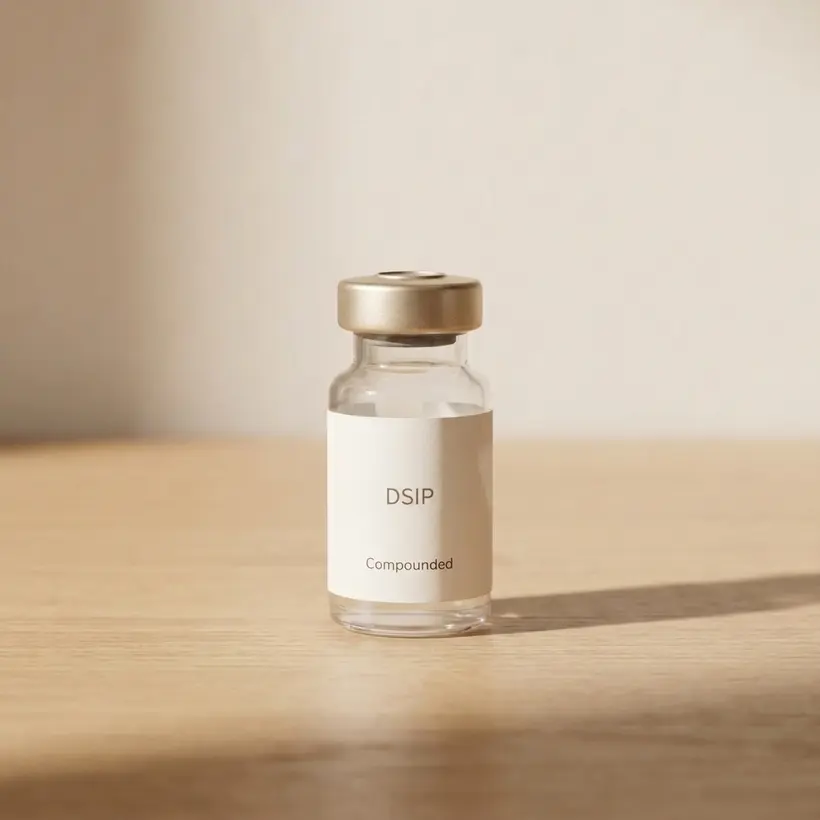
DSIP (Delta Sleep-Inducing Peptide)
Injectable

Sleep & Stress

A neuropeptide studied in research on delta-wave sleep

01

Studied in EEG sleep research for its role in slow-wave (Stage N3) sleep

02

Research has examined tolerance and dependence measures over multi-month studies

03

Investigated for its effect on circadian cortisol rhythm

Sleep & Stress

DSIP (Delta Sleep-Inducing Peptide)

DSIP is an endogenous neuropeptide studied in research for its role in delta-wave (slow-wave) sleep.

5mg vial · 1mg/mL · 5mL99.0% purity

Choose your plan

Peptide checkout

1. Purchase type

2. Choose billing term

How this plan works

Pay

$429.30 today

Renews every 3 months

Ship

Every 3 months

After provider approval

Refills

Paid quarterly

Continues until canceled

Continue with 3-month plan → $429.30
Peptide checkout
Provider review
Ships after approval

A U.S.-licensed provider reviews your request before it ships. If you are not approved, you are refunded in full.

Quick answer

DSIP is an endogenous neuropeptide studied in research for its role in delta-wave (slow-wave) sleep.

Format

Injectable

Best use

Sleep & Stress

Evidence

Research-framed

503A Pharmacy
USP <797> Sterile
Provider-Reviewed
Lab-Tested
Cold-Chain
HIPAA

Deep research

About DSIP (Delta Sleep-Inducing Peptide)

DSIP (Delta Sleep-Inducing Peptide) is an endogenous nonapeptide (sequence Trp-Ala-Gly-Gly-Asp-Ala-Ser-Gly-Glu, MW ~848 Da) first isolated from rabbit cerebral venous blood by Schoenenberger and Monnier in 1977 at the University of Basel. It is found naturally in the human hypothalamus, pituitary, and peripheral organs, with plasma concentrations showing a circadian rhythm that peaks at night. Its full receptor pharmacology remains under investigation.

Lyophilized DSIP is stored at -20C and is stable for extended periods. Reconstituted with bacteriostatic water, it is refrigerated at 2-8C and used within a few weeks. The peptide is sensitive to oxidation at the tryptophan residue, so it is protected from light and used promptly after reconstitution.
Key benefits

What researchers have looked at

1

Studied in EEG sleep research for its role in slow-wave (Stage N3) sleep

2

Research has examined tolerance and dependence measures over multi-month studies

3

Investigated for its effect on circadian cortisol rhythm

4

Studied for measures of sleep onset latency in insomnia research

5

Examined in relation to growth hormone release during deep sleep

6

Research describes a hit-and-run signaling pattern outlasting its short half-life

7

Does not suppress respiratory drive in the studied models, unlike GABAergic sedatives

8

Studied for preservation of REM proportions while affecting slow-wave stages

Mechanism

How DSIP (Delta Sleep-Inducing Peptide) is positioned in research

Research describes DSIP acting on hypothalamic sleep-wake regulation centers rather than through the GABAergic mechanism of benzodiazepines and Z-drugs. The literature reports modulation of neuronal firing in the ventrolateral preoptic area (VLPO) and suprachiasmatic nucleus (SCN), influence on serotonergic and glutamatergic transmission, and circadian-dependent modulation of ACTH, cortisol, and growth hormone. Plasma half-life is approximately 7-8 minutes, but effects on sleep architecture are reported to persist far longer, and DSIP crosses the blood-brain barrier via a saturable transport system.

Published research

What the research has explored

DSIP has been studied across European research centers using EEG polysomnography to examine slow-wave (N3) sleep, sleep onset latency in insomnia, and circadian cortisol patterns. Long-term administration studies have examined tolerance, dependence, and rebound measures. Published adverse effects are limited to occasional mild injection site reactions.

For research and educational purposes only. References to studies describe published literature and do not constitute medical claims, efficacy guarantees, or treatment recommendations.

Questions people ask

Frequently asked questions

What is DSIP?+

DSIP (Delta Sleep-Inducing Peptide) is an endogenous nonapeptide (MW ~848 Da) first isolated in 1977. It is studied in research on slow-wave sleep and circadian rhythm.

How is DSIP different from sleep sedatives?+

Research describes DSIP acting on hypothalamic sleep-wake centers rather than through GABAergic potentiation, and it does not suppress respiratory drive in the studied models.

How is DSIP stored?+

Lyophilized DSIP is stored at -20C and refrigerated at 2-8C after reconstitution. It is protected from light due to tryptophan oxidation sensitivity.

Concentration

1mg/mL · 5mL

Purity

99.0%

Format

Injectable

Vial

5mg vial

Compare next

Related peptides