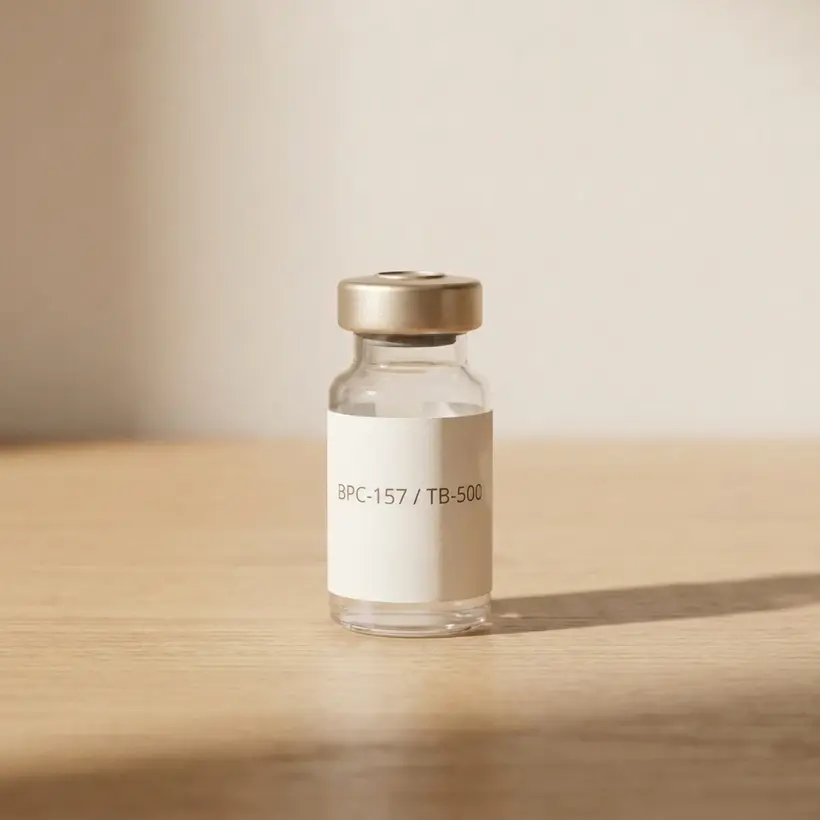
BPC-157 / TB-500 Blend
Top SellerBlend

Recovery & Healing

A two-peptide recovery blend in one vial

01

Combines BPC-157 and TB-500, studied together in recovery research

02

Research describes complementary local (BPC-157) and systemic (TB-500) signaling

03

Investigated for combined effects on VEGF/EGF and actin-migration pathways

Recovery & Healing

BPC-157 / TB-500 Blend

This blend combines BPC-157 and TB-500, two peptides studied in research for complementary roles in tissue repair, in one co-formulated vial.

5mL vial · BPC-157 15mg + TB-500 15mg99.0% purity

Choose your plan

Peptide checkout

1. Purchase type

2. Choose billing term

How this plan works

Pay

$618.30 today

Renews every 3 months

Ship

Every 3 months

After provider approval

Refills

Paid quarterly

Continues until canceled

Continue with 3-month plan → $618.30
Peptide checkout
Provider review
Ships after approval

A U.S.-licensed provider reviews your request before it ships. If you are not approved, you are refunded in full.

Quick answer

This blend combines BPC-157 and TB-500, two peptides studied in research for complementary roles in tissue repair, in one co-formulated vial.

Format

Blend

Best use

Recovery & Healing

Evidence

Research-framed

503A Pharmacy
USP <797> Sterile
Provider-Reviewed
Lab-Tested
Cold-Chain
HIPAA

Deep research

About BPC-157 / TB-500 Blend

This blend combines two structurally and mechanistically distinct peptides: BPC-157 (a 15-amino-acid pentadecapeptide, MW ~1419 Da, sequence GEPPPGKPADDAGLV) and TB-500 (a synthetic 43-amino-acid replica of Thymosin Beta-4, MW ~4921 Da). The peptides are co-lyophilized and maintain stability in the blended format. The rationale studied in research is that their mechanisms are complementary: BPC-157 acts largely at the local tissue level, while TB-500, as a G-actin sequestering peptide, is associated with cytoskeletal reorganization and cell migration more systemically.

The co-lyophilized blend is stored lyophilized at -20C and reconstituted with bacteriostatic water directed gently against the vial wall. The reconstituted solution is stored at 2-8C and not frozen. Both peptides are stable across the same pH range (4.0-8.0).
Key benefits

What researchers have looked at

1

Combines BPC-157 and TB-500, studied together in recovery research

2

Research describes complementary local (BPC-157) and systemic (TB-500) signaling

3

Investigated for combined effects on VEGF/EGF and actin-migration pathways

4

Studied for the role of each peptide across phases of tissue repair

5

Single-vial reconstitution delivers a consistent ratio at every dose

6

Co-formulated in a ratio matching published combination research protocols

7

Recovery-focused option for tendon, ligament, and soft-tissue interests

8

No emergent toxicity beyond the individual component profiles in published studies

Mechanism

How BPC-157 / TB-500 Blend is positioned in research

Research describes BPC-157 interacting with VEGF and EGF expression, the nitric oxide system, and the FAK-paxillin pathway at the local level, while TB-500 is associated with G-actin sequestration, cell migration, and Akt survival signaling. Studied together, the literature describes activation of early-phase (TB-500) and mid-to-late-phase (BPC-157) repair signaling, with the proposed effect of supporting different stages of tissue repair concurrently.

Published research

What the research has explored

BPC-157 and TB-500 have each been studied across recovery and tissue-repair models, predominantly in animals, and have been examined together in combination research. Published studies report no emergent toxicity from the combination beyond the individual component profiles. Human clinical trial data for these peptides remains limited.

For research and educational purposes only. References to studies describe published literature and do not constitute medical claims, efficacy guarantees, or treatment recommendations.

Questions people ask

Frequently asked questions

What is in this blend?+

It co-formulates BPC-157 (MW ~1419 Da) and TB-500 (MW ~4921 Da), two peptides studied in recovery research, in a single vial at a fixed ratio.

Why combine them?+

Research describes complementary mechanisms: BPC-157 acts largely locally (VEGF/EGF, NO system), while TB-500 is associated with systemic cell migration via actin regulation.

How is the blend reconstituted?+

The co-lyophilized vial is stored at -20C and reconstituted gently with bacteriostatic water, then refrigerated at 2-8C and not frozen.

Concentration

BPC-157 15mg + TB-500 15mg

Purity

99.0%

Format

Blend

Vial

5mL vial

Compare next

Related peptides